A Tesla that won’t start is almost always a 12V battery or a missed key fob. Seven checks from the curb save a tow in LA County. Here’s the seven-step check before you call for help.
Step one: check the key fob
A Tesla with a weak key fob battery sometimes won’t authenticate. The car acts bricked. The screen stays dark. The handles don’t present.
Replace the fob battery if you can. Most Tesla fobs take a CR2032. The battery is in the fob’s case. A small screwdriver opens the case.
If you don’t have a replacement battery, try the Tesla app’s unlock command. The app can unlock the car in some cases.
Step two: check the Tesla app
The Tesla app shows the car’s state of charge, the lock status, and the climate status. A car that shows as offline in the app has a 12V problem.
A car that shows as online but reads zero has a traction pack problem. The 12V is fine in this case. The traction pack is empty.
Tesla dead 12V or high-voltage pack covers the two failure modes in more detail.
Step three: confirm Park
The Tesla won’t start in Neutral or Drive. The gear selector must be in Park. The column-mounted lever on the Model S and Model X. The center screen selector on the Model 3 and Model Y.
If the car doesn’t recognize Park, the start sequence won’t engage. The driver shifts to Park again. The car recognizes the gear and starts.
Step four: check the brake
The brake pedal must be pressed to start the car. A stiff brake pedal means the brake booster isn’t getting 12V. The 12V is dead.
A soft brake pedal with normal feel means the 12V is fine. The driver presses the brake and the start button. The car starts.
Step five: look at the headlights
The Tesla’s headlights tell you whether the 12V is alive. If the headlights are off and the Tesla logo doesn’t appear on the screen, the 12V is dead.
If the headlights come on but the car refuses to drive, the traction pack is empty. The 12V is fine. The pack needs electrons.
Step six: try the manual unlock
A driver who can’t get into the Tesla through the key fob uses the mechanical key hidden in the fob. The mechanical key unlocks the driver’s door.
The mechanical keyhole is hidden behind a cover on the driver’s door handle. The driver pulls the cover off with the key. The key turns the lock. The door opens.
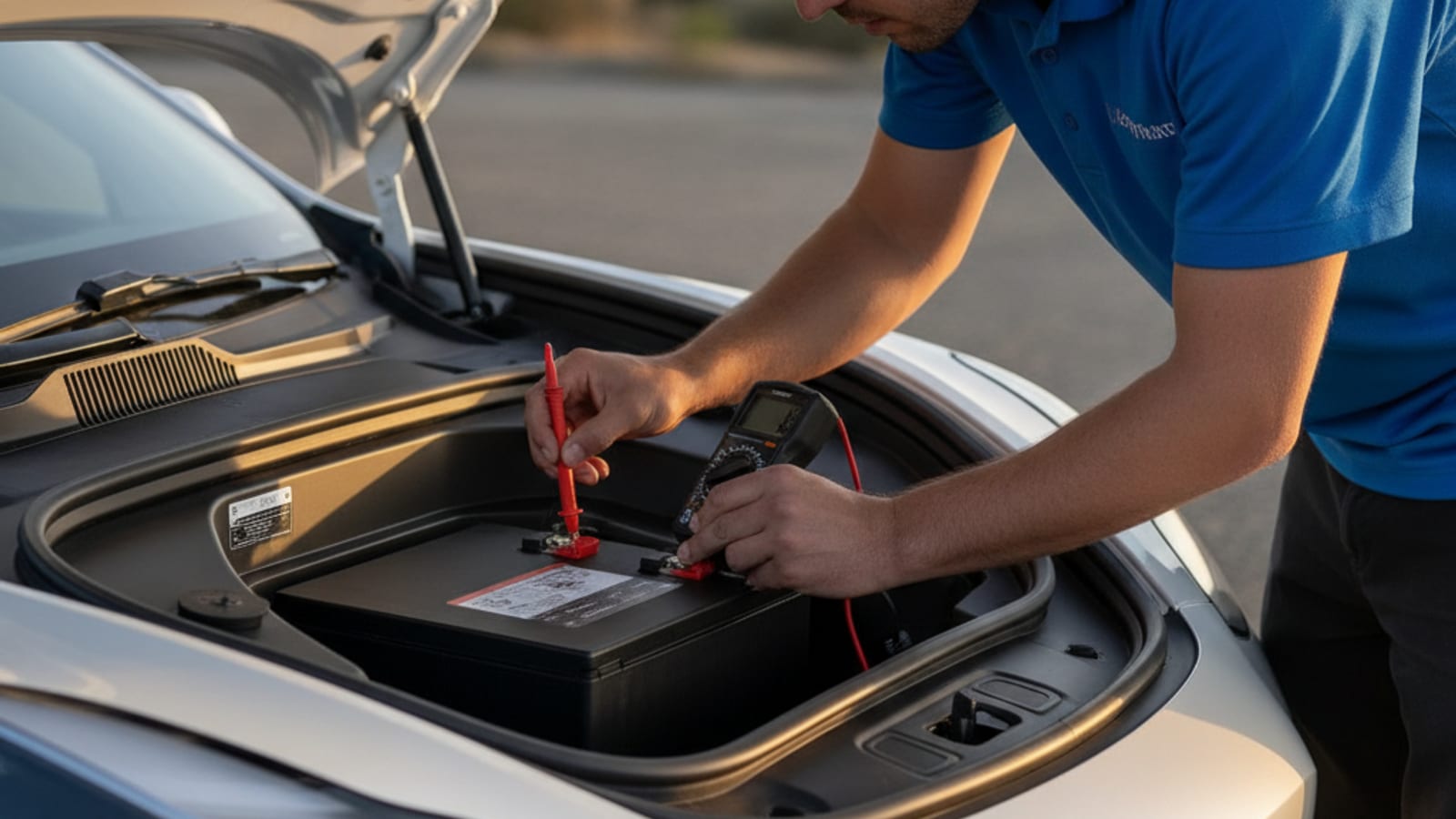
Once inside, the driver can pop the hood using the Tesla’s emergency hood release. The 12V terminals are accessible.
Step seven: try a 12V jump
A driver with a portable jump pack can wake the Tesla’s 12V. The driver connects the positive clamp to the positive terminal under the hood and the negative clamp to a chassis ground point.
The Tesla’s computer wakes within a few seconds. The contactors close once the 12V is back to a normal voltage. The Tesla is now in a normal Ready state.
What to do if the seven checks don’t help
A driver who has tried the seven checks and the Tesla still won’t start needs a mobile operator or a tow. The operator brings a portable jump pack and a replacement 12V battery. They jump the existing battery first. If the jump wakes the car and the battery holds a charge, the driver drives off.
If the jump doesn’t wake the car, the failure isn’t the 12V. The operator confirms the diagnosis and recommends a tow to a Tesla Service Center.
We’re a referral line for Los Angeles County. We match stranded EV drivers with independent local operators. The pros we connect you with are licensed and insured. We hold no license for the work. We own no trucks and employ no technicians. We set no prices and publish no arrival time.
The operator quotes you before they start. They bill you directly. No dollar figure belongs here. They quote you on the phone and confirm access before they roll.
Tesla 12V is dead: how to tell, then how to jump it covers the diagnosis and jump path in more detail.
What about the traction pack
A Tesla with a healthy 12V but an empty traction pack needs electrons at the charge port. The mobile operator brings 240V Level 2 to the car. The driver gets 10 to 20 miles to reach a charger.
Tesla at zero on the road: charge in place or wait for a tow covers the traction pack version in more detail.
The combined answer
A Tesla that won’t start is almost always a 12V or a missed key fob. Seven checks from the curb save a tow. A driver who can’t wake the car with the checks needs a mobile operator or a tow to a Service Center.
The number to call is (213) 410-1991. We’ll match you with a local operator. They quote before any cable goes in.