Your Tesla is parked underground, but the doors, screen, or app won’t respond. Before requesting a Tesla 12V jump in Beverly Hills, gather enough information to distinguish a low-voltage problem from an empty main battery.
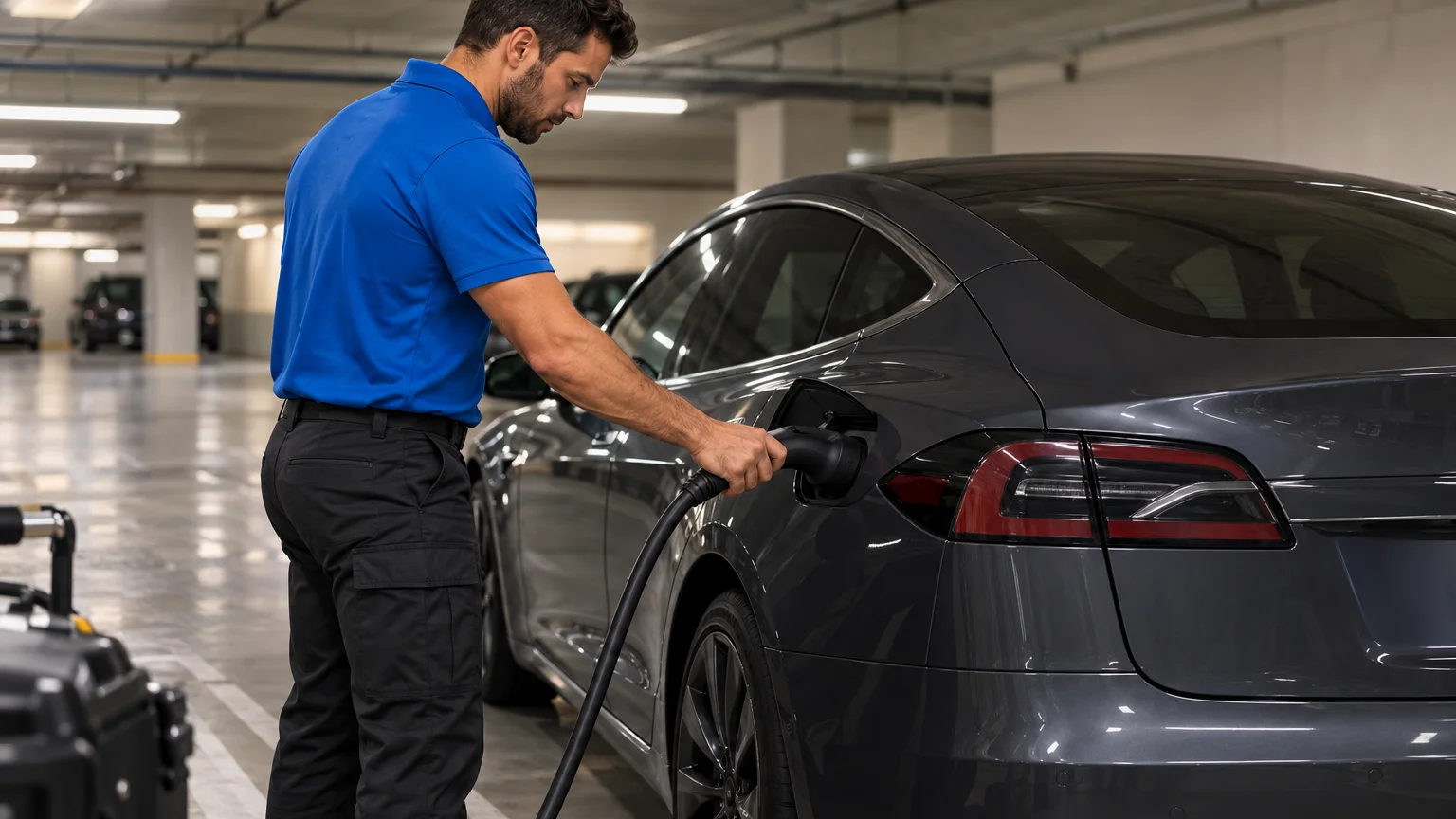
A garage adds another problem: the operator must be able to reach the vehicle. Gate access, clearance, parking level, and the car’s position can affect which rescue option is practical.
Dead 12V versus an empty main battery
A Tesla that won’t wake doesn’t reveal the cause by that symptom alone. The low-voltage system and main battery pack serve different roles. A roadside operator needs more context before deciding whether a jump, mobile charge, or tow fits the situation.
Start with what happened before the car became unresponsive. Note the last displayed range or battery percentage, if you saw it. Record any low-voltage warning shown on the touchscreen or in the Tesla app. Also mention whether the car was charging, parked normally, or already low on range.
Tesla says a vehicle can display an alert when its low-voltage battery needs replacement. That alert directs the owner to schedule service. If you saw one, repeat its exact wording to the operator. Don’t rely on a remembered summary if the message remains visible in the app.
A completely dark car doesn’t prove the main pack is empty. Likewise, a low range reading doesn’t confirm that low voltage is the only issue. Our guide to a dead Tesla 12V battery versus the high-voltage pack explains the diagnostic difference in more detail.
Vehicle age alone isn’t enough to identify the battery type or correct access procedure. Tesla configurations differ by model and production date. Share the model, model year, and any available VIN details. The matched operator can then check the correct Tesla documentation.
Charge Pro LA connects drivers with independent local operators. We don’t diagnose the vehicle remotely or perform the jump ourselves. The operator evaluates the available clues and tells you which service is appropriate.
Checks to make before requesting a jump
Begin with observation, not disassembly. Try the normal key method available for your Tesla, then check the Tesla app. Write down what responds and what stays dark. Exact details help more than saying the car is “dead.”
Look for these clues without removing panels or connecting equipment:
- Whether the app connects to the vehicle
- Whether the doors respond to the normal key method
- Whether exterior or interior lights illuminate
- Whether the touchscreen displays a message
- Whether a charge cable is connected
- Whether you saw a low-voltage alert earlier
- Whether the main battery was already near empty
- Whether there’s visible collision, water, smoke, or heat damage
If there’s visible damage or another immediate hazard, don’t treat the situation as a routine jump request. Tell the garage staff and the operator exactly what you see.
Use the Tesla owner’s manual for your exact model and model year before attempting any access procedure. The approved steps aren’t interchangeable across every Tesla. If you can’t confirm the procedure, leave the work to a qualified operator.
Tesla’s Model Y manual says the vehicle cannot be used to jump-start another vehicle because doing so can cause damage. Its jump-start instructions assume an external low-voltage supply, such as a portable jump starter. That’s different from using your Tesla as the donor vehicle.
A Tesla service note also gives specific limits for vehicles with lead-acid 12V batteries. It says a battery below 10.5 volts should be replaced. The note also limits charger voltage and current. Those figures are technician guidance for that battery type, not permission to guess your vehicle’s configuration.
For hands-on help, request a Tesla 12V battery jump and provide the observed symptoms first.
Garage access details dispatch needs
A dead Tesla inside a Beverly Hills parking structure is partly a vehicle problem and partly an access problem. The local operator needs a clear picture of the garage before selecting equipment or accepting the job.
Send the complete street address supplied by the property. Then give the garage entrance location in plain terms. If the property has several entrances, identify the one that reaches your parking area. Don’t assume a map pin leads to the correct gate.
Include these details with the request:
- The parking level and marked space number
- The posted vehicle-clearance limit
- Whether the entrance uses a ticket, call box, key, or access code
- Whether an attendant, valet, resident, or manager controls entry
- The route from the entrance to the vehicle
- Any tight turns, ramps, columns, or overhead barriers
- Whether the Tesla faces into or away from the driving aisle
- Whether another vehicle blocks access
- Whether phone service works near the car
Photos can make these details clearer. Photograph the clearance sign, entrance, nearest turn, parking space, and open area around the Tesla. Avoid including access codes, license plates, or residents in images unless necessary.
Don’t state that a named garage allows roadside work unless its authorized representative confirms it. Garage rules weren’t verified for this page. Ask the property manager, valet, attendant, or security contact whether an outside operator may enter and where the work can occur.
Tesla gives similar preparation advice for Mobile Service appointments. It asks owners to make the vehicle accessible, provide adequate working space, and share gate information or access codes. Those details are also useful when arranging local Tesla roadside rescue, though the independent operator sets its own access requirements.
Why clearance and locked gates matter
An operator can’t plan around a clearance limit that wasn’t disclosed. A garage entrance may restrict the vehicle or equipment that can reach the Tesla. A locked gate can stop access entirely if nobody on site has authority to open it.
Read the posted clearance sign rather than estimating. Send a photo when possible. Charge Pro LA doesn’t own rescue vehicles or equipment, so we can’t promise that a particular setup will fit. The independent operator decides whether access is workable after reviewing the details.
Gate authority matters just as much. A resident code may open one entrance but not another. A valet area may have different controls from resident parking. A commercial structure may require approval before an outside operator enters. These policies vary by property and couldn’t be confirmed as one Beverly Hills rule.
Contact the person who controls the property before the operator arrives. Ask whether roadside service is permitted at the parked location. If it isn’t, ask whether the property has an approved service area or another process. Don’t move the vehicle unless the manufacturer’s instructions and the responding professional support that step.
Private-property towing is governed by California Vehicle Code 22658. The law addresses matters including signage, authorization, notice, and owner-return release. It doesn’t establish that every garage must admit a mobile operator. Property access still needs confirmation from the person authorized to manage that site.
The city’s broader rescue considerations are covered in our guide to EV roadside assistance in Beverly Hills. This page focuses on the narrower problem of an unresponsive Tesla inside a structure.
Good access notes help the operator assess the job honestly. They don’t create an arrival promise or guarantee that the vehicle can be serviced in its space.
When a jump will not solve the problem
A jump is one possible diagnostic and recovery step. It isn’t proof that the Tesla only needs temporary low-voltage power. The operator may find that the vehicle needs battery replacement, manufacturer service, mobile charging, or towing instead.
Tesla’s maintenance guidance says the vehicle alerts the owner when the low-voltage battery needs replacement. If the car wakes after external support but displays that warning, don’t treat the warning as resolved. Record it and follow the service direction shown by the vehicle.
Tesla’s service note is more direct for lead-acid 12V batteries. When the measured charge falls below 10.5 volts, the note calls for replacement. That determination depends on proper testing and confirming the battery type. It shouldn’t be inferred from a dark screen alone.
A jump also won’t refill an empty main battery pack. If the low-voltage system responds but the drive battery has no usable charge, the next step may be mobile charging or a tow. The correct choice depends on vehicle condition, garage access, and the operator’s assessment.
Other faults can also remain after low-voltage support. The car may continue showing an error, refuse to shift, or stay inaccessible. Don’t keep repeating unverified procedures. Share every new message with the operator and follow the owner’s manual for your exact vehicle.
If the Tesla needs manufacturer attention, Tesla says Mobile Service appointments are scheduled through its app. Tesla also asks owners to provide location instructions, gate details, and enough working space. Availability for your vehicle and garage wasn’t confirmed here, so check the app directly.
A local rescue operator handles the immediate roadside assessment. Tesla determines its own service and warranty coverage. Charge Pro LA doesn’t set prices, give warranties, or decide whether a repair is covered.
When to call us
Call when your Tesla won’t wake and a Beverly Hills garage makes access complicated. Have the model, symptoms, parking level, clearance, gate instructions, and property approval ready.
Call us at (213) 410-1991 and we’ll connect you with a local EV rescue operator.