A Volvo XC40 or C40 Recharge that won’t start is almost always a 12-volt battery, not the traction pack. The Volvo EVs share a platform with the Polestar 2. The 12V behavior is similar. Here’s the Volvo 12V roadside path and the first fixes to try.
What a no-start Volvo looks like
The dashboard stays dark. The Volvo logo doesn’t appear on the center screen. You press the brake and the start button and nothing happens. The car is awake enough to beep the key fob, but the contactors don’t close. The brake may feel stiff because the brake booster needs 12V to operate normally.
That’s a 12V failure. The traction pack is fine. The Volvo’s high-voltage system won’t close its contactors when the 12V can’t power the computer. The car acts bricked even though the big pack is fine.
This happens most often after a long sit. The Volvo sits for a week while you’re traveling. The 12V drains slowly during the sit. When you return, the 12V is below the voltage the computer needs to wake.
Where the 12V sits in the Volvo
The 12V battery in the XC40 and C40 Recharge sits under the hood. It’s a conventional absorbed glass mat (AGM) battery in most trims. The positive terminal has a red cover. The jump procedure uses the standard 12V jump points shown in the owner’s manual.
A roadside operator can jump the 12V from under the hood without removing any covers. The Volvo’s high-voltage system is isolated and safe during a 12V jump. The pack stays de-energized until the contactors close, which only happens after the 12V is back to a normal voltage.
First checks before you call
Confirm the key fob battery isn’t dead. A Volvo with a weak fob battery sometimes won’t authenticate and acts bricked. Replace the fob battery first if you can.
Confirm the car is in Park. The Volvo won’t start in Neutral or Drive. The gear selector is a small electronic button on the center console.
Look at the 12V voltage if you have a meter. Below 11.5V at rest means the battery is drained. Below 10V, the battery is dead and probably needs replacement.
If the 12V reads below 11.5V, the next step is a jump or a replacement. That’s where a mobile operator comes in.
What the operator brings
We’re a referral line for Los Angeles County. We match stranded EV drivers with independent local operators. The pros we connect you with are licensed and insured. We hold no license for the work. We own no trucks and employ no technicians. We set no prices and publish no arrival time.
The operator quotes you before they start. They bill you directly. No dollar figure belongs here. They quote you on the phone and confirm access before they roll.
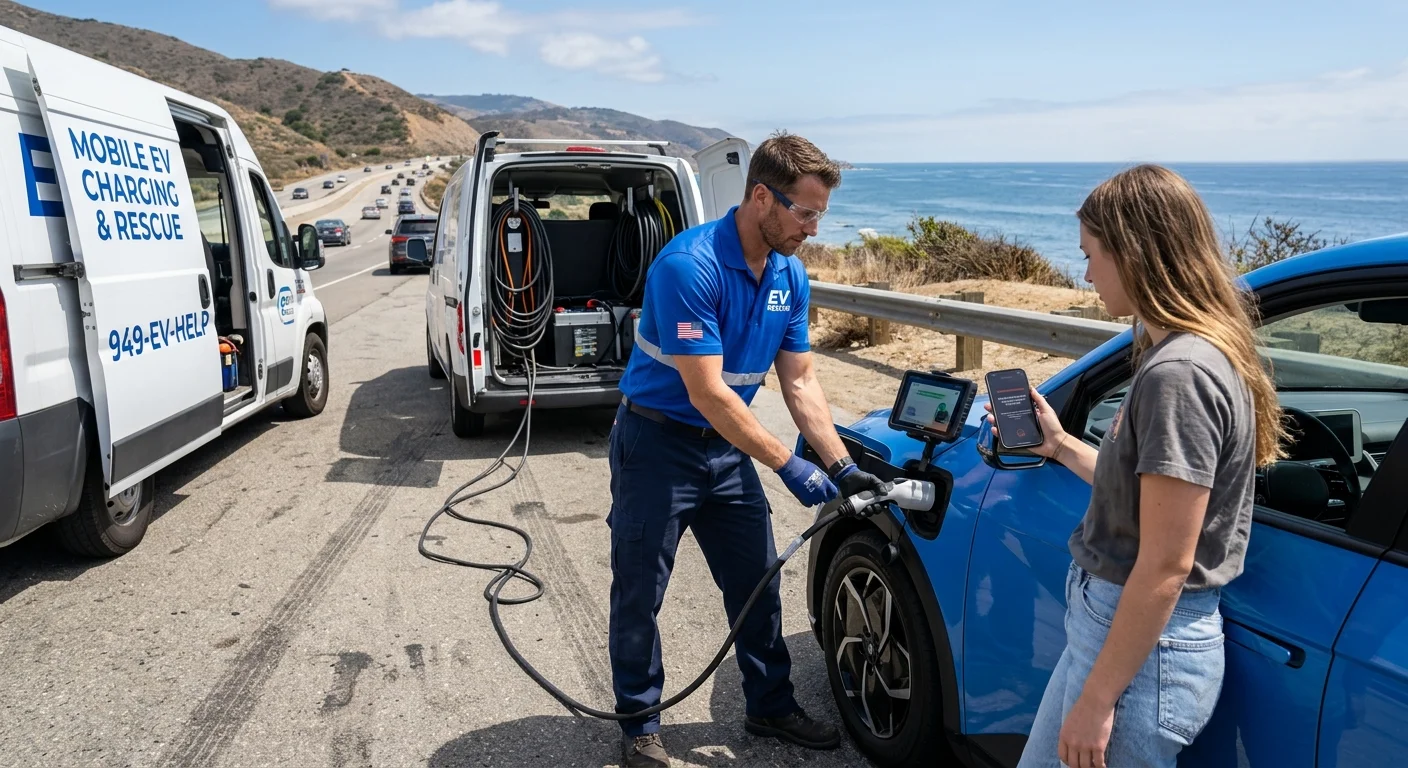
For the Volvo, the operator brings a 12V jump pack and a replacement AGM battery. They jump the existing battery first. If the jump wakes the car and the battery holds a charge, you drive off. If the jump wakes the car and the battery won’t hold, they replace it on site.
If the car won’t wake after a jump, the failure isn’t the 12V. The operator will tell you on the call before they start any further work.
Why Volvo 12V batteries die in LA County
Heat ages 12V batteries faster than mild weather. LA County summers hit 90F and above. A Volvo parked on a driveway in the sun all day in August loses 12V capacity faster than the same car parked in a garage.
A week of vacation does it too. A car that sits in a structure or on a curb for seven days returns to a 12V that’s been slowly draining the whole time. The Volvo’s small 12V doesn’t have much reserve.
The fix is a jump to wake the car. The fix may also be a battery replacement if the old one won’t hold a charge.
The Volvo roadside program
Volvo’s roadside assistance covers tows through a third-party dispatch. The dispatch goes through Volvo’s call center. Volvo tows to the nearest Volvo dealer. Volvo does not always send a mobile charger.
A Volvo driver who needs electrons at the pin gets a tow under Volvo’s program. A Volvo driver who needs a mobile charge gets the same tow unless the contractor carries a charging van. Most contractors in LA County carry a flatbed.
What about the traction pack
The Volvo’s traction pack is the part that drives the wheels. It’s a large lithium-ion pack that holds the miles. It almost never fails in a roadside situation. The traction pack is also the part that the operator can’t service on site. A traction pack fault is a flatbed to a Volvo dealer.
A no-start Volvo with a healthy 12V is a different problem. The operator can confirm the 12V is healthy on the call and recommend a tow to a dealer if the failure is somewhere else.
After the jump
Once the Volvo wakes up, drive it for at least 30 minutes. The DC-DC converter charges the 12V from the traction pack while the car is moving. A short hop won’t bring the 12V back to full.
If the 12V was drained because the car sat for a week, drive it for an hour and the 12V should be back to normal. If the 12V was drained because the battery itself is at end of life, replace it. The operator can replace it on site if that’s the diagnosis.
The number to call is (213) 410-1991. We’ll match you with a local operator. They quote before any cable goes in.