A Volkswagen ID.4 that sits silent in a Los Angeles driveway can still have range left in the drive pack. The 12-volt battery is a separate system, and when it is worn the car can refuse to wake, unlock, or show a clear screen. Replacement is not a Charge Pro LA job. A local operator or a Volkswagen dealer does the swap, and the only procedure that belongs here is the one in your model-year owner’s manual.
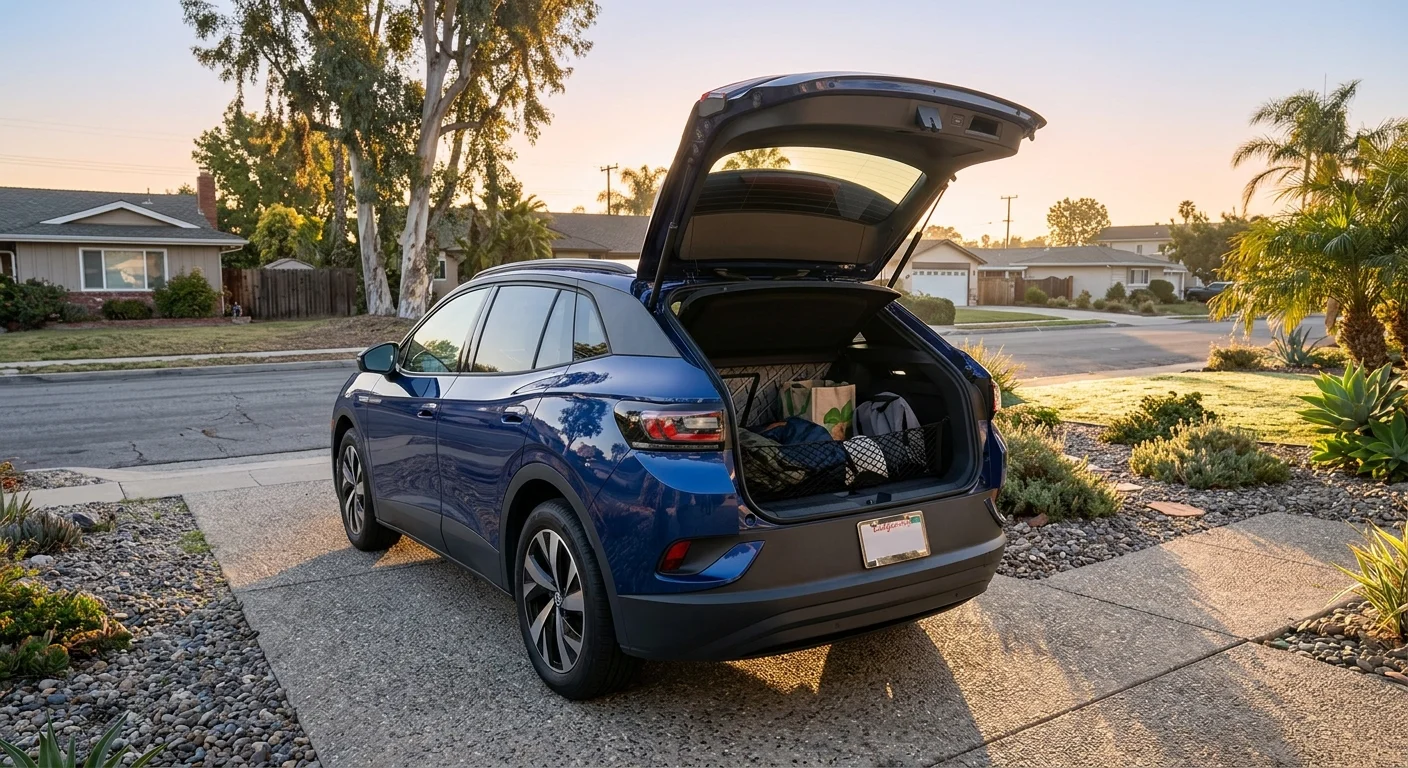
Signs the ID.4 12V is done, not the drive pack
The ID.4 uses a high-voltage pack to move the car and a separate low-voltage battery for locks, screens, and the circuitry that lets the pack connect. That split shows up across electric vehicles, including in the U.S. Department of Energy’s electric vehicle overview. It is not a Volkswagen diagnosis. It is the reason a car can look dead while the traction pack still holds charge.
Photograph whatever is on the cluster or the infotainment. Write down whether the doors unlock, whether the fob works, and whether the last range figure you saw still looks plausible. Sluggish windows or a slow screen can have more than one cause. Hand those notes to an operator or a dealer. Do not treat them as a DIY verdict.
If you need the wake-the-car sequence rather than a replacement plan, start with Volkswagen ID.4 12V battery failures: what to do. That page is about getting the car to respond. This page is about what happens when a jump is only buying time. For the broader pattern across EVs, EV 12V battery replacement signs and steps covers the two-system idea without turning it into a Volkswagen procedure.
A silent ID.4 with remaining range is a real roadside task. How often it happens on your build is a Volkswagen or shop question. Frequency claims are not on this page.
If the car is in a traffic lane, call 911. California Vehicle Code 21718 prohibits stopping on a freeway, with an exception for a disabled vehicle when help has been summoned. California Vehicle Code 21809 is the move-over law for stopped emergency, tow, or Caltrans vehicles displaying flashing lights. On a designated LA County freeway beat, Metro Freeway Service Patrol is free. Dial 511 and say Motorist Aid. FSP’s published list includes jump-starting cars, tire changes, a gallon of fuel, and tows to a safe spot off the freeway. It does not include mobile EV charging. Hours are Monday through Friday 6am to 7pm and weekends 10am to 6:30pm. Do not assume a patrol truck will treat an ID.4 12V the way it treats a gas-car battery.
What Volkswagen publishes, and what it does not
Volkswagen publishes an owner’s manual for each U.S. model year of the ID.4. That book is the source for battery location, jump terminals, polarity, and any warning about using the car as a donor. Charge Pro LA does not reprint those diagrams. We do not have a captured U.S. ID.4 jump-start page in our verified facts file. If a video or a forum post puts the battery in the front compartment, under a cargo panel, or behind a strut bar, treat that as unofficial until your manual agrees.
Open the emergency or jump-start section for your year. Follow only those terminals. Do not use a gas-car clamp order. Do not treat Tesla hood-release wires as ID.4 jump points. A Model Y tow-eye lead is not an ID.4 procedure. If the manual tells you to use remote posts instead of the battery case, believe that. If it forbids using the ID.4 as a donor, believe that too.
Volkswagen also does not publish, in any source we have verified, a replacement price, a labor-hour figure, or a wait time for Los Angeles dealers. Those numbers stay off this page. A parts listing or a cost estimator is their figure, not ours, and it is not confirmed here.
Chemistry is year-specific as well. Owner threads talk about flooded, EFB, or AGM batteries, and about coding a new unit so the car charges it correctly. None of that is in our verified facts file. Do not pick a battery off a shelf because a podcast used a nickname for it. Ask the shop that will install it, and confirm the part against the VIN.
The same rule covers tools. Aftermarket scan tools show up in owner videos. Volkswagen does not publish a Charge Pro coding spec. If a dealer or independent shop says the new 12V has to be registered, that is their process. It is not a step we perform.
An ID. Buzz is a different Volkswagen. Its 12-volt layout belongs in that model’s manual, not in this one.
A curb-side jump versus a dealer replacement
A curb-side jump can wake an ID.4 long enough to roll it off a red curb in Silver Lake or out of a stall at a Torrance grocery lot. It does not prove the 12V is healthy. If the battery is worn, the car can go silent again after the next sit. Replacement, coding, and parts are shop or operator questions.
A dealer replacement is the path when you want Volkswagen to own the part choice and any software steps their service department uses. An independent EV-capable shop is the path when you already have a trusted wrench. Charge Pro LA is neither. We are a referral service. We match you with a licensed, independent local operator. That operator confirms whether they can attempt a jump, a mobile charge, or a tow for that VIN, connector, and location. They quote you before work starts. You contract with them. We set no price.
Do not treat a jump as a repair. Do not treat a tow to a dealer as a confirmed 12V diagnosis until the shop tests the battery. A high-voltage pack that is empty is a different job. If the car is awake and the range is gone, you need charging, not a 12-volt swap. The U.S. DOE Alternative Fuels Data Center describes AC Level 2 equipment from 2.9 to 19.2 kW. A typical rescue charge on our network is 10 to 20 miles of range in 15 to 30 minutes of Level 2 charging. That is charging time, not arrival time. Compatibility still depends on the exact vehicle and equipment.
If you are choosing between a wake-up and a charge, emergency EV roadside assistance is the service page for a stranded EV in Los Angeles County. For Volkswagen and other non-Tesla models, use non-Tesla EV rescue. Tesla owners use Tesla’s own channels for Tesla-specific 12V work.
GEICO Emergency Road Service, when that optional coverage is on the policy, lists battery jump starts among covered items. It does not name electric vehicles or mobile EV charging. A GEICO jump dispatch is not an ID.4 replacement plan. Confirm with the insurer what they will send.
Heat-soaked South Bay and Valley garages
Los Angeles County is not one climate. An ID.4 that lives in a closed garage off Van Nuys Boulevard sits in a different heat box than one parked in the marine layer in Redondo Beach or El Segundo. We do not have verified station temperatures for this page, so there is no July-max figure here. The geography is still real.
South Bay housing is old. In Torrance, 83.3 percent of housing was built before 1980. Redondo Beach is 66.7 percent. Those streets mean tight driveways, older garages, and cars that sit closed-up after a 405 crawl through the Sepulveda Pass. The San Fernando Valley is inland. Burbank’s housing stock is 72.8 percent pre-1980. Glendale is 70.7 percent. Santa Clarita is newer, at 30.4 percent pre-1980, but the 5 and the 14 still cook a parked ID.4 after a long inland commute. Palmdale and Lancaster add desert soaks, with much newer housing and long lots that still leave a dark ID.4 baking if it sits outside.
Heat is hard on any 12-volt battery. That is a general fact of this kind of battery, not a Volkswagen statistic we can quote. What you can do is stop treating a South Bay morning and a Valley afternoon as the same sit. A car that went quiet overnight in a Burbank garage may need a replacement conversation, not another jump, if the same warning has already come back.
If the ID.4 is on the 101 through the Valley, or on the 405, do not wait on the right-of-way. California Vehicle Code 22651(f) lets a peace officer remove a vehicle left more than four hours on a freeway right-of-way when the driver cannot move it under its own power. Get it to a driveway, a legal stall, or a shop. Then decide jump versus replacement with the manual and the person doing the work.
How Charge Pro LA connects a local operator
Charge Pro LA connects ID.4 drivers in Los Angeles County with licensed, independent local operators. We do not replace a Volkswagen 12V. We do not run dealer service. We do not own trucks, a fleet, or a parts warehouse. We hold no trade license for that work. The operator who takes the job is the one who inspects the car, names the work, and bills you.
Call with the year, the exact warning you photographed, and the location: a South Gate driveway, a Santa Monica garage, a shoulder on the 110, a stall near SoFi. The operator confirms whether they can attempt a low-voltage jump, a Level 2 rescue charge, or a tow. If they cannot do the work safely at that spot, they say so before you agree to a price.
You pay the operator. We do not quote a Charge Pro fee, a waiver, or a free inspection. We do not promise a clock time.
If the traction pack is the problem rather than the 12V, say that up front. If the car is already at a Volkswagen dealer, stay on that path for parts and any software the shop requires. Use us when you need a local referral for a stranded non-Tesla EV and the dealer is not the next move.
When to call us
Call when you cannot follow the owner’s manual safely, you have no donor equipment, or the ID.4 is already in a traffic lane or a tow-away bind. A worn 12V that keeps going silent after a jump is also a reason to get a local operator on the phone instead of guessing at parts. Call us at (213) 410-1991 and we’ll connect you with a local EV rescue operator.