The Kia Niro EV is a compact crossover. Plenty of them in Los Angeles County live in older apartment lots. Census figures put pre-1980 housing at 71.0 percent in the City of Los Angeles. East Los Angeles sits at 86.2 percent. Whittier is 88.9 percent, and Lakewood is 88.8 percent. Those buildings were wired for gas cars. A dedicated 240-volt stall is rare in that stock. The Niro sits unplugged for days, and then the 12-volt battery dies. The traction pack can still show a healthy charge. The dash stays dark, and the start button does nothing.
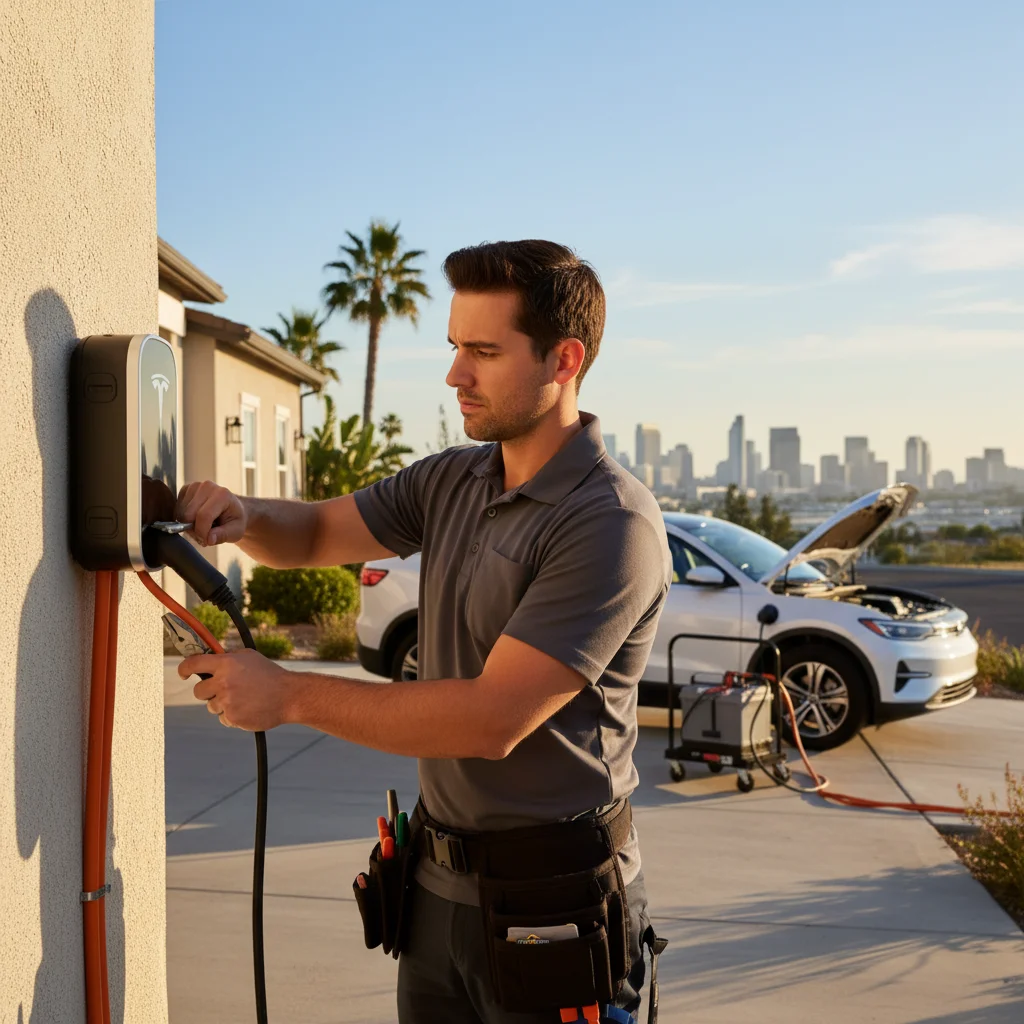
Dark dash versus a low pack
A Niro EV that won’t wake usually isn’t empty. The car uses two batteries, and they fail in different ways. The large lithium-ion pack moves the wheels. A small 12-volt battery runs the computers, locks, alarm, and the wake relay. When that 12-volt cell is flat, nothing talks to anything. You get a brick with a charged pack. The main pack can hold plenty of charge and still not help.
You can tell the two failures apart from the curb.
A dead 12-volt looks like this. The cluster is fully dark, with no click and no chime. The fob unlock is slow, weak, or silent. Hazard lights won’t come on either. The car sat for a week or more with no plug.
A depleted traction pack looks different. The dash still wakes and shows a turtle warning. Doors, lights, and the screen still work. The car drove normally until range ran out.
If the screens are black, start with the 12-volt. If the car is talking and warning you, you need energy in the main pack. A jump won’t fill an empty traction battery. A CCS charge won’t wake a dead 12-volt. Get that split right before you call anyone.
For the failure sequence across brands, read when an EV 12V dies.
Why older Los Angeles housing drains a compact EV
The Niro EV is small, and it fits tight city lots. That’s why it shows up in older neighborhoods. It’s also why it sits unplugged between errands.
In Culver City, 85.5 percent of housing predates 1980. West Hollywood is 80.5 percent, and Santa Monica is 75.0 percent. Long Beach is 79.6 percent, and Inglewood is 78.3 percent. Huntington Park is 76.7 percent, and Alhambra is 72.6 percent. Renters in that stock often can’t add a home charger. Panels are old, and parking is assigned and shared. Building rules block new circuits in a lot of those lots.
The car then lives on workplace plugs and public stalls. A week of errands with no overnight charge is common. The 12-volt still powers the alarm, telematics, and sleep modules the whole time. After enough idle days, that small battery is done. The traction pack never topped the 12-volt back up through the DC-DC converter.
If your building won’t take a Level 2 circuit, old electrical panel, no home charger walks through the backup path. LADWP serves the City of Los Angeles and publishes a residential EV charger rebate. Most of the rest of the county is Southern California Edison territory. Several cities buy generation through Clean Power Alliance while SCE still delivers the power. Glendale, Burbank, Pasadena, and Azusa run their own municipal utilities. None of that helps a Niro that already won’t wake in the lot.
What actually stops a Niro EV from starting
Kia sold the Niro EV from 2019 through 2022. A redesigned Niro EV followed for 2023 through 2025.
These are the usual no-start causes, in the order owners actually see them.
A flat or weak 12-volt auxiliary battery is first. You get a blank dash, no start-button response, and no lock beep. A jump at the under-hood posts often restores Ready mode.
A long sleep with parasitic drain is next. The car sat two weeks or more, and modules never fully slept. A 12-volt jump usually brings the screens back.
Loose or corroded 12-volt terminals cause intermittent starts. Warning lights flicker on and off. Cleaning and retightening the clamps is a curb-side check you can do.
A dead key-fob cell is easy to miss. The car won’t see the fob, so you can’t get in. Swap the CR2032, or use the physical key in the door.
A failed 12-volt Battery Saver relay shows up as repeat drains. The 12-volt dies again over a few days. That needs a shop scan, not another jump.
A high-voltage interlock fault is less common. The 12-volt is fine, but Ready never engages. That’s dealer work with a scan tool.
Coastal humidity in Santa Monica, Redondo Beach, and Manhattan Beach can corrode terminals. Check the clamps before you assume the battery is finished. Heat in the San Fernando Valley, the San Gabriel Valley, and the Antelope Valley is harder on parked electronics. Idle time plus no plug is the real drain. A dark dash is the warning.
The Kia EV9 has a similar 12-volt no-start pattern. If you share a household with one, Kia EV9 won’t start covers that model.
Jump posts, not the battery posts
On a Niro EV the 12-volt battery sits under the hood. It’s on the driver’s side, near the firewall, under a plastic cover. You can reach it without pulling major parts. The 2023-and-later body keeps that same general spot.
Don’t clamp onto the battery terminals. Kia put dedicated jump posts in the bay. Look for a red positive cover marked plus. Use an unpainted chassis ground for the negative. Those posts are the safe points.
- Set a jump pack so the cables reach the bay.
- Open the red positive cover on the Niro and clip the red lead there.
- Clip the other red lead to the donor positive, or the pack’s positive.
- Clip the black lead to the donor negative, or the pack’s negative.
- Clip the remaining black lead to unpainted metal on the Niro, not the battery negative.
- Wait two to three minutes, then press the start button.
- If Ready appears, pull the cables in reverse, negative first.
- Drive so the DC-DC converter can refill the 12-volt. Don’t shut the car down until you arrive.
Skip a diesel-truck booster on this car. The Niro’s 12-volt is a small pack. A standard 12-volt jump starter is enough.
The same method for any EV is in how to jump start an electric car without damage. What a roadside tech can jump is covered in can roadside assistance jump-start an EV, or only the 12V.
Turn on 12V Battery Save if you have it
The 2023 to 2025 Niro EV has a 12V Battery Save setting. It lives in the vehicle menu. When it’s on, the converter tops the 12-volt more often while you charge the pack.
Path: Settings, then Vehicle, then 12V Battery Save, then On.
This doesn’t repair a dying cell. It can slow the drain if the car sits more than a week without a plug. Kia added the toggle after early owners saw repeat 12-volt events.
If Battery Save is on and the 12-volt still dies within days, go to a shop. The battery or a module needs diagnosis. Repeated jumps are a clue, not a cure.
Charge the pack only when the dash can talk
A mobile Level 2 boost helps when the pack is empty and the car still communicates. Operators in the Charge Pro LA network bring a 240-volt Level 2 source to the car. They use a CCS or J1772 adapter on non-Tesla EVs. A typical session adds 10 to 20 miles of range in 15 to 30 minutes of charging. That’s charging time, not an arrival time.
If the 12-volt is dead, the charge port won’t handshake. Wake the 12-volt first, then decide if the pack itself needs energy.
Non-Tesla EV rescue is the service page for Kia, Hyundai, and other CCS cars. The operator quotes you before any work starts and bills you directly. Charge Pro LA doesn’t own trucks, set prices, or perform the work.
If you’re stuck in Los Angeles County
Stay out of live lanes if you can, and put the hazards on. California Vehicle Code 21718 bars stopping on a freeway. A disabled vehicle is an exception once you’ve summoned help. California Vehicle Code 21809 is the move-over rule. Other drivers must change lanes or slow for a stopped service vehicle with lights.
Metro Freeway Service Patrol is free on congested county freeways. Caltrans, CHP, and LA Metro run it. Published help includes a gallon of gas, a radiator refill, and a tire change. FSP also tows a disabled car free to a CHP-chosen safe spot. The list doesn’t include mobile EV charging. An empty Niro is outside that published menu, other than the tow to a safe place. Dial 511 and say Motorist Aid if you need FSP. For a 12-volt jump or a CCS boost, you still need an EV-capable operator.
California Vehicle Code 22658 governs tows from private property. Required entrance signage, written authorization, and notice rules apply. If the owner returns before the car leaves the lot, the vehicle must be released. Don’t leave a dark Niro sitting for hours in a posted garage.
LAX parking is a common 12-volt trap after a trip. Terminal structures P1 through P7 in the Central Terminal Area offer Level 2 and DC fast charging. The Economy Parking garage has more than 4,000 stalls and 514 active EV chargers. A week in any of those lots can still kill the 12-volt. Garage chargers don’t keep that small battery alive if the car never wakes. The same parked-car pattern shows up after flights into Hollywood Burbank Airport and Long Beach Airport. Confirm charger details on each airport’s own site.
Eastside and Gateway apartment belts see this compact-EV pattern a lot. East Los Angeles EV charging is the local hub page if that’s where the car sits. Older streets, shared lots, and no overnight plug are the usual mix. South Gate, Huntington Park, and Commerce sit in the same belt.
On the 5 north of Castaic, a low pack and a long grade are a different problem. That’s a traction-pack issue, not a 12-volt one. Keep the two failures separate when you describe the car on the phone.
What to tell the operator
Say it’s a Kia Niro EV. Give the model year if you know it. Say whether the dash is dark or warning you. Give the exact lot, level, and stall if you’re in a garage. On a freeway, give the highway, direction, and the last exit you passed.
Charge Pro LA is a referral line. It matches stranded EV drivers with independent local mobile rescue operators. It doesn’t hold a license, own equipment, or employ technicians. The operator who takes the job quotes you first. The pros they send handle Tesla and every major EV brand, including Kia.
If basic checks aren’t waking the car, call (213) 410-1991. Leave the location and the Niro’s year. The operator who accepts the job sets the rest with you.
Frequently asked questions
Can a full traction pack still leave a Niro EV dead?
Yes. The 12-volt battery powers the modules that wake the main pack. If that small battery is dead, the start button does nothing. The charge port won’t talk either. A 12-volt jump is the first fix. Charging the traction pack comes after the car can communicate.
Where do the jumper cables go on a Kia Niro EV?
Use the under-hood jump posts, not the battery terminals. The red positive post sits in the bay near the firewall. The negative goes to unpainted chassis metal. Wait two to three minutes, then press start. If Ready comes up, disconnect negative first. Drive so the DC-DC converter can refill the 12-volt.
When do you need a mobile charge instead of a jump?
When the dash wakes and shows a low pack, you need energy in the traction battery. A jump won’t add range. Independent operators can bring a 240-volt Level 2 source and a CCS adapter. If the dash is black, jump the 12-volt first. Then see whether the pack itself is empty.